Ryna Script Font: Elegant & Sweet for Handmade Labels & Invitations
As a maker who’s spent years designing candle labels, wedding welcome boards, printable planner pages, and SVG cut files for Etsy shops, I know how much a single font can shape the feeling—and sales—of a product. When I first opened Ryna, I paused. Not because it was flashy or loud, but because it felt like a quiet confidence: smooth curves, gentle contrast, and just enough personality to feel handmade without sacrificing polish. Ryna is a Script Amp font—not overly ornate, not too casual—and that sweet spot makes it one of the most commercially versatile script fonts I’ve added to my design toolkit.
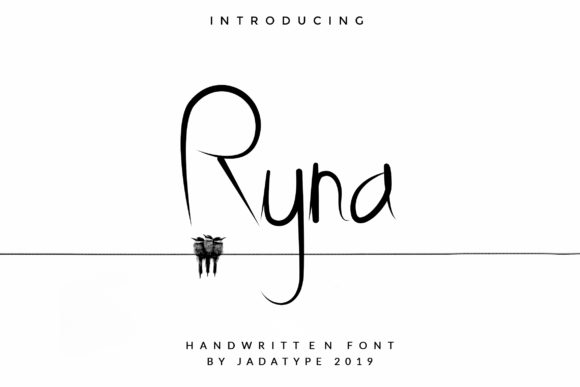
Ryna’s charm lies in its balance. It’s elegant enough for a luxury bridal suite, yet warm and approachable for a small-batch soap label. The letterforms flow with natural rhythm—no awkward joins or abrupt terminals—and the spacing between characters feels intuitive, even at small sizes. That’s rare in script fonts. Many look gorgeous on a mockup but turn muddy when cut at 0.25” on vinyl or printed at 8pt on a product tag. Ryna holds up. I’ve used it successfully on 3/4” sticker sheets for boutique gift tags, and customers consistently comment on how “clean” and “legible” the handwriting-style text looks—even from across a craft fair booth.
For physical product makers, readability isn’t optional—it’s part of your brand promise. Ryna shines in high-visibility spots: jar labels for honey or bath salts, chalkboard-style signs for farmers’ markets, foil-stamped greeting cards, and heat-transfer designs for linen tea towels. Its smoothness translates beautifully to both digital print and physical cutting machines. On Cricut Design Space and Silhouette Studio, Ryna cuts cleanly without excessive nodes or fragile serifs. I’ve tested it down to 0.18” height on matte vinyl stickers—still legible, still graceful.
Wedding and event creators will find Ryna especially useful. It’s not fussy like calligraphic scripts that demand perfect alignment, nor is it so minimal it fades into the background. Use it for couple names on save-the-dates, “Welcome” on farmhouse-style signage, or monogrammed napkin prints. Because Ryna includes stylistic alternates and subtle swashes (check the OTF file!), you can add delicate flair to initials or titles without overcomplicating your layout. And yes—it supports extended Latin characters, so names with accents (José, naïve, résumé) render correctly on international orders or bilingual invitations.
What really sets Ryna apart for commercial use is its adaptability across formats. I’ve layered it over textured watercolor backgrounds in printable wall art, used it as the sole typographic element in minimalist mug mockups, and paired it with clean sans serifs for editable Canva templates sold as digital downloads. It works equally well for seasonal collections: think “Cozy & Covered” on autumn sweater tags, “Sunshine & Sea Salt” on summer candle jars, or “Joyful & Jolly” on holiday packaging. The font doesn’t shout—it invites. And that emotional resonance helps customers connect before they even read the full description.
Ryna is best used for short, impactful text: product names, headers, quotes, names, and decorative phrases. It’s not intended for body copy—but that’s exactly where its strength lies. In craft and printable design, we rarely need long paragraphs in script. We need *presence*. A single word in Ryna—“Bloom,” “Gather,” “Dear”—carries weight. For longer text blocks (like instructions on a printable recipe card), pair Ryna with a friendly sans serif like Montserrat or Poppins. That contrast gives hierarchy, breath, and professionalism. If you’re building a cohesive brand kit, try Ryna + a soft serif like Playfair Display for headings and a neutral sans for captions—it creates warmth without clutter.
File-wise, Ryna comes in OTF format with full OpenType features: ligatures, contextual alternates, and swash options baked in. No extra downloads or workarounds needed. You’ll get consistent results whether you’re designing in Adobe Illustrator, Affinity Designer, or free tools like Gravit Designer. And because it’s a premium font built for real-world use, the kerning has been fine-tuned—not just auto-generated—so letters sit together naturally, even across different letter combinations.
Licensing matters—especially when you’re selling physical goods or digital assets. Ryna includes an extended commercial license, meaning you can use it freely in client work, on merchandise (mugs, shirts, tote bags), in SVG bundles, printable templates, and even embedded in Canva templates you sell. Just remember: you can’t resell the font file itself or claim it as your own design. But using Ryna to craft a beautiful candle label? A heartfelt baby announcement? A branded shop sign? That’s exactly what it was made for.
I keep Ryna in my top-three go-to fonts—not because it’s the flashiest, but because it delivers every time. It elevates a $6 sticker without raising production costs. It makes a DIY invitation feel thoughtfully designed, not hastily assembled. And it helps my small shop stand out in a crowded marketplace—not by shouting louder, but by speaking more clearly, more warmly, more authentically. If your products carry heart, Ryna carries that tone forward, quietly and consistently.
Whether you’re printing on kraft paper tags, cutting glitter vinyl for boutique jewelry displays, or designing a digital download bundle for fellow creatives, Ryna meets your needs without demanding perfection from your workflow. It’s elegant, yes—but never precious. Sweet, yes—but never saccharine. Smooth, yes—but always substantial. That’s why it’s become my default script for anything that needs to feel handmade, human, and just a little bit special.